.avif)
Every Arcadia portfolio rests on three beliefs about how markets behave. A philosophy earns its keep during the stretches when sticking with it feels hardest: a sharp drawdown, a hot sector everyone seems to own, a forecast that sounds convincing on the news.
Without an investment philosophy, investment decisions tend to drift toward whatever felt urgent that month. With one, each decision can be checked against something stable. Below are the three beliefs, how they shape the portfolios we build, and how we manage investment portfolios over time.
Millions of buyers and sellers trade every day, and the prices they settle on reflect an enormous amount of information. A professional who believes a stock is mispriced is betting that their judgment beats the combined judgment of everyone else trading it, after paying the costs of trying.
The long-run record on that bet is poor. Research going back decades, including S&P's ongoing SPIVA scorecards, finds that a large majority of actively managed stock funds trail their benchmarks over long periods, and the funds that do outperform rarely keep it up.
So we don't pick individual stocks, and we don't move portfolios in and out of the market based on economic forecasts. Our job is to own markets broadly and capture what they deliver at a low cost.
Owning the whole market is a strong starting point, and we build from there. Decades of academic research, much of it from economists Eugene Fama and Kenneth French, have found that certain groups of stocks delivered higher returns over long periods: smaller companies, companies priced low relative to their fundamentals, and companies with higher profitability. These differences appear across countries and decades, and they have sensible explanations rooted in risk and investor behavior.
We tilt our stock holdings modestly toward these characteristics using funds from Dimensional Fund Advisors and Avantis Investors. Both firms follow a systematic, rules-based process. Instead of forecasting earnings or picking favorites, they hold thousands of securities, lean toward those with higher expected returns, and trade patiently to keep costs down. Vanguard index funds fill in where plain market exposure is the better tool.
The tilt stays modest for a reason. These return premiums carry no guarantee and can disappear for years at a time, as value stocks did for much of the 2010s. A measured tilt lets clients benefit when the premiums show up without staking the plan on them.
Nobody knows what markets will return next year, but we do know what a fund charges and, with planning, roughly what a trade will cost in taxes.
We keep the weighted average expense ratio of every portfolio below 0.20%. Our advisory fee is a flat fee, so clients see exactly what they pay us in dollars, and that number doesn't climb simply because their portfolio grew.
Taxes often cost investors more than fees do. Holding the right assets in the right accounts, harvesting losses, and managing the timing of capital gains can add meaningful after-tax value, particularly for retirees drawing from several account types at once.
The most consequential decision in any portfolio is the split between stocks and bonds, and for us that decision comes out of the financial plan. A client's goals, time horizon, spending needs, and comfort with market swings set the mix. Two clients with identical balances can end up with very different portfolios, and they should.
The stock side is globally diversified across U.S., international developed, and emerging markets, with the modest tilt described above. We use a handful of funds (generally exchange-traded funds (ETFs), which keeps each portfolio easy to understand and monitor.
The bond side has a narrower role: steadying the portfolio and funding withdrawals when stocks are down. For that reason we generally hold investment-grade bonds and U.S. Treasuries with short to intermediate maturities. Reaching for extra yield through lower-quality or longer-dated bonds tends to add risk at exactly the moment stability is needed most.
Markets move, and allocations drift with them. A 60% stocks/40% bonds portfolio left alone through a strong decade for stocks can end up closer to 80% stocks/20% bonds, carrying far more risk than the client signed up for. We rebalance when an asset class moves outside a set tolerance band around its target, which keeps risk in line without trading on a fixed calendar for its own sake.
Whenever possible, we rebalance with new contributions and planned withdrawals before selling anything, and we check the tax cost of each trade before placing it. In taxable accounts, short-term market declines become chances to harvest losses that can offset future gains.
The hardest part of investing is behavioral. Selling during a downturn locks in the loss and often means missing the recovery that follows. A large part of our role is helping clients stay with their plan when markets are unsettling, since that is when discipline pays off.
A philosophy is defined as much by what it leaves out. We don't generaly buy individual stocks, time the market, or use complex, high-cost products such as structured notes, non-traded REITs, private equity or alternative investments.
None of this removes risk. Stock markets can fall sharply and stay down for years, and the size, value, and profitability premiums can trail the broader market for long stretches. International investments carry currency and political risk, bonds can lose value when interest rates rise, and rebalancing can lower returns in markets that trend in one direction for a long time.
What our approach offers is a portfolio grounded in academic research, low in cost, mindful of taxes, and managed with a consistent discipline.
Disclosure: Arcadia Private Wealth LLC is an Investment Adviser offering services in California and in other jurisdictions where exempt from registration. Registration doesn't imply a specific skill level or endorsement. Not legal/accounting/tax advice. Information is believed accurate but not guaranteed and isn't a complete analysis. All investments carry risk of profit or loss. Consult a professional before investing. Opinions reflect authors' views at time of posting and may change. Not responsible for third-party comments. Nothing here is an offer to buy/sell securities or personalized financial, legal, or tax advice. Consult an attorney or tax professional for your specific situation.
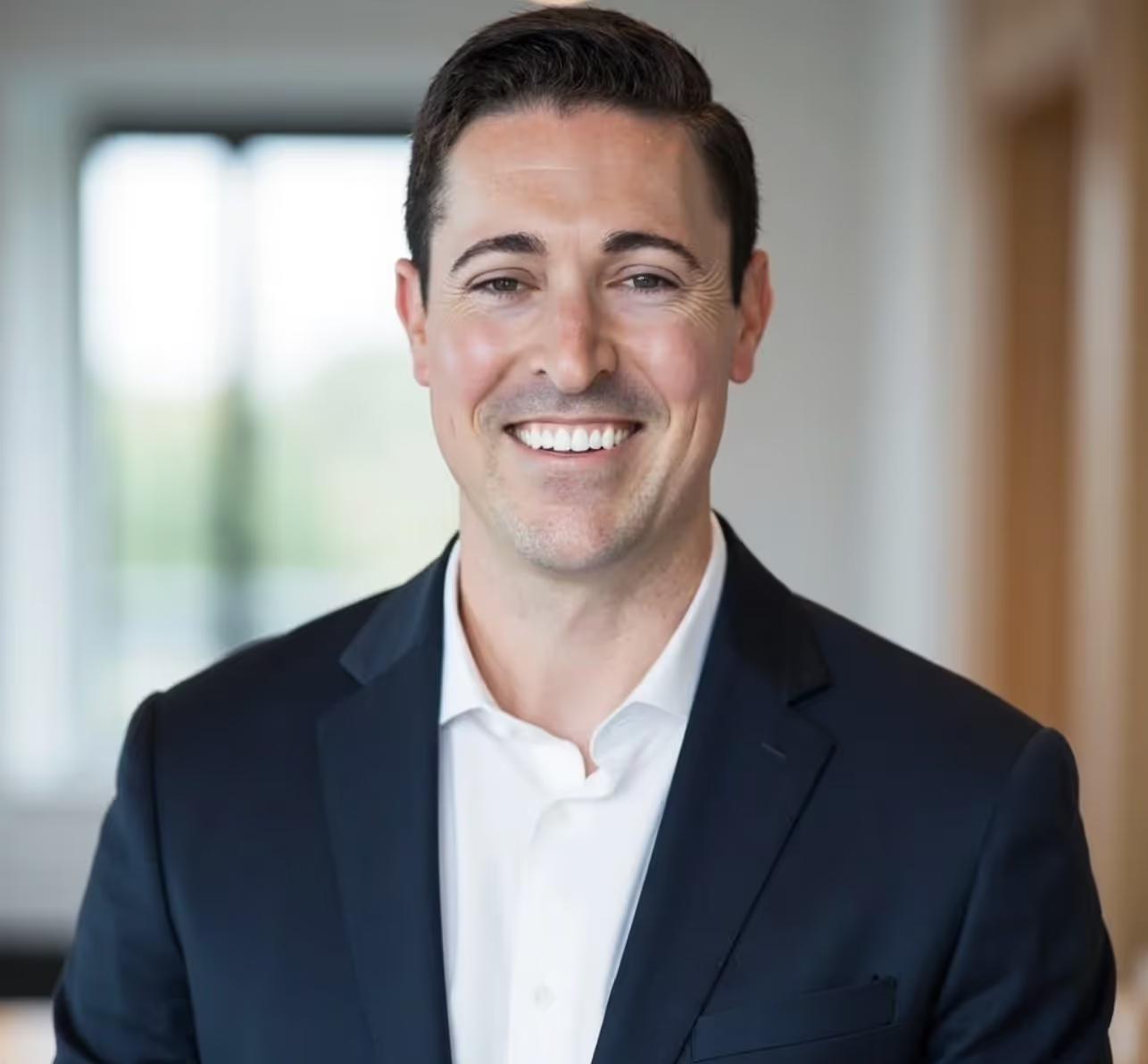
Grant Webster, CFP®, TPCP®
Founder, Wealth Advisor