.avif)
There is a shift that happens in wealth planning around a certain point.
Early in life, the primary question is accumulation: how do I save more, invest better, and build something meaningful? Over time, for families who build real wealth, the question gradually transforms. How do I protect what I have built? How do I use it wisely during my lifetime? And eventually: how do I make sure it reaches the people and causes I care about, in the way I intend?
This last question is the one most families are unprepared for.
Studies consistently show that a significant majority of family wealth does not survive past the third generation. The reasons are rarely market performance or investment selection. They are planning gaps, tax drag, unprepared heirs, family conflict, and the absence of any framework for what the wealth is supposed to do.
Building a lasting legacy is not primarily a financial question. It is a planning question.
Generational wealth is commonly described as assets passed from one generation to the next. That description is technically accurate but incomplete.
The families who successfully transfer wealth across multiple generations are not the ones with the most assets. They are the ones who transfer, alongside the assets, the values, the knowledge, the discipline, and the decision-making frameworks that allowed the wealth to be created in the first place.
A portfolio without those things is just a number. With a pending estate, a tax bill, a complex family dynamic, and heirs who have never thought seriously about money, that number can erode faster than anyone expects.
The goal of legacy planning is not to pass down as many dollars as possible. It is to pass down the conditions under which those dollars can be used wisely, thoughtfully, and in alignment with what the family actually values. That requires a fundamentally different kind of planning than most people undertake.
Estate taxes, gift taxes, and capital gains taxes are real costs and genuine planning challenges. But they account for only part of the erosion.
Research from the Williams Group, which studied wealth transitions across more than 3,000 families over several decades, found that 70% of family wealth transfers fail by the second generation, and 90% by the third. The reasons were overwhelmingly non-financial: breakdowns in family communication, a lack of trust among family members, unprepared heirs, and the absence of a shared family mission.
Taxes mattered. But they were not the primary variable.
This has significant implications for how families approach legacy planning. A strategy focused exclusively on minimizing estate taxes while neglecting heir preparation and family communication is addressing a real problem while ignoring the more common and more consequential ones.
The families who do this well address both dimensions simultaneously.
That said, taxes are genuinely important, and the decisions made around transfer timing, account structure, and estate design have a direct and measurable impact on how much wealth reaches the next generation.
The current exemption landscape. In 2026, the federal estate, gift, and generation-skipping transfer (GST) tax exemptions stand at $15 million per individual and $30 million per married couple, following the passage of the One Big Beautiful Bill Act in July 2025. For families below these thresholds, federal estate tax is not the primary concern. For families above them, the excess is taxed at a 40% federal rate, and California adds its own complexity through income and capital gains taxes on assets that do not receive a step-up in basis.
The step-up in basis question. When appreciated assets transfer at death, heirs typically receive a step-up in basis to the fair market value at the date of death. This eliminates the capital gains tax on decades of accumulated appreciation. This is one of the most significant tax benefits available in estate planning, and it directly affects whether large lifetime gifts of appreciated assets are the right strategy. Gifting highly appreciated stock during life transfers the original cost basis to the recipient, meaning they pay capital gains tax when they sell. Holding it until death eliminates that gain entirely for the heir. This calculation should be run carefully before executing any large gift of appreciated assets.
Annual exclusion gifting. The 2026 annual gift tax exclusion is $19,000 per recipient, or $38,000 for a married couple. With multiple children and grandchildren, the cumulative effect over time can be substantial without touching the lifetime exemption. A couple with three married children can give $228,000 per year with no gift tax return required. Direct tuition payments and direct medical payments are excluded entirely beyond this limit.
Roth conversions as a wealth transfer tool. For families with large Traditional IRA balances, converting pre-tax funds to Roth during lower-income years serves two purposes simultaneously. It reduces future Required Minimum Distributions, which reduces the ongoing ordinary income tax burden. And it builds a pool of after-tax, tax-free wealth that can pass to heirs without the income tax burden that comes with inherited Traditional IRA distributions. Under the SECURE Act, most non-spouse beneficiaries must deplete inherited IRAs within 10 years, making the tax efficiency of Roth conversions especially relevant for legacy planning.
Trusts as a tax and control tool. Irrevocable trusts serve multiple functions in legacy planning: removing assets from the taxable estate, protecting assets from creditors and divorce, controlling the timing and conditions of distributions to heirs, and in some cases providing significant tax efficiency through structures like Intentionally Defective Grantor Trusts or Grantor Retained Annuity Trusts.
Not all trusts serve the same purpose, and the choice among them depends on the specific goals, family dynamics, and asset composition of each family. Here is a practical summary of the structures most relevant to high-net-worth families thinking about legacy planning.
Revocable Living Trust. The most common starting point. Assets in a revocable trust pass outside probate, which provides privacy and simplifies the transfer process. The grantor retains full control during their lifetime and can modify or revoke the trust at any time. It does not provide estate tax protection, asset protection from creditors, or generation-skipping planning. Think of it as the organizational foundation, not the full strategy.
Irrevocable Life Insurance Trust (ILIT). A trust that owns a life insurance policy, keeping the proceeds outside the taxable estate. The insurance proceeds flow to trust beneficiaries free of estate tax. Useful for providing liquidity to pay estate costs or equalize inheritances among heirs.
Dynasty Trust. A long-term irrevocable trust funded with GST exemption, designed to benefit multiple generations. Assets inside the trust grow and pass through generations without being subject to estate tax at each generational transfer. In states that have eliminated the rule against perpetuities, including Nevada, South Dakota, and Delaware, these trusts can theoretically last for generations. A dynasty trust funded with $10 million today, growing at 6% annually, passes $32 million to the next generation in 20 years and over $100 million in 40 years, without estate tax at each transfer.
Spousal Lifetime Access Trust (SLAT). An irrevocable trust funded by one spouse for the benefit of the other spouse and descendants. Removes assets from the funding spouse's taxable estate while allowing the other spouse to access the assets. Particularly relevant in 2026 as families look to lock in the current $15 million exemption before any potential future changes.
Charitable Remainder Trust (CRT). Allows a family to contribute appreciated assets, receive an income stream for a term of years or for life, receive a partial charitable deduction, and pass the remainder to charity. Particularly useful for highly appreciated, low-basis assets where an outright sale would generate a large capital gains bill.
The most carefully designed trust structure in the world cannot compensate for heirs who are unprepared, emotionally conflicted, or financially unsophisticated.
This is the dimension families most frequently neglect, and it is the one that most frequently determines the outcome.
Preparing heirs does not mean revealing every financial detail to a 16-year-old or turning family gatherings into financial planning workshops. It means being deliberate, over many years, about building the knowledge, the values, and the relational context that will allow the next generation to handle significant wealth responsibly.
In practice, this typically involves several things.
Starting early with financial education. Children and grandchildren who grow up with some exposure to budgeting, investing, and the concept of financial responsibility are far better positioned to receive significant wealth than those who encounter it for the first time at 35 with no preparation. This does not require formal programs or complex curricula. It requires ongoing, age-appropriate conversations about money, values, and decision-making.
Involving adult heirs in relevant conversations. When children reach adulthood, bringing them into discussions about the family's financial intentions helps demystify what will eventually happen and allows them to form realistic expectations. Families who avoid these conversations until death are setting their heirs up for confusion, conflict, and resentment.
Aligning expectations proactively. One of the most common sources of family conflict following an estate transfer is unequal treatment that heirs did not anticipate. A child who is active in the family business may receive different treatment than a child who is not. A grandchild with special needs may have a different trust structure than a sibling. If these decisions are explained and contextualized before the estate is distributed, they are far more likely to be accepted as intentional and fair. If they are revealed through a will reading, they often produce exactly the opposite reaction.
Sharing the values behind the plan. The most resonant legacy planning conversations are not about numbers. They are about what the wealth is for, what the family values, what the wealth-building generation hopes for the generations to come, and what responsibilities they believe come with significant financial resources. An ethical will or letter of wishes, which is a personal document separate from legal instruments, can be a powerful tool for communicating these values in a durable, personal way.
For families with substantial wealth that will involve multiple family members in ongoing financial decisions, some form of family governance structure is worth considering.
Family governance is not complicated bureaucracy. It is simply a set of agreed-upon processes for how the family makes shared financial decisions. This might include regular family meetings where financial matters are discussed and decisions are made collaboratively, a family mission statement that articulates the shared values and purposes behind the family's wealth, a family investment policy statement that governs how shared assets are managed, and an agreed-upon process for admitting spouses into financial conversations over time.
The families that manage significant multigenerational wealth most effectively are often the ones who treat the family unit itself as an institution with governance structures, not just a collection of individuals who happen to be related.
Returning to the Williams Group research: the primary reasons family wealth fails to transfer successfully are communication breakdowns and unprepared heirs. Both are addressable. Neither requires legal structures to fix.
The families who communicate openly about wealth, who share their intentions and the reasoning behind them, who invite the next generation into conversations rather than surprising them with documents, tend to produce better outcomes across every dimension. The financial plan lasts longer. The family relationships survive the transitions better. The heirs are more capable stewards of what they receive.
The families who treat wealth as a private matter to be revealed only upon death tend to produce the opposite: surprised, sometimes resentful heirs without the context or preparation to manage what they have received.
The most valuable thing a financial advisor can do in legacy planning is often not the technical work. It is creating the space and framework for these conversations to happen.
An estate and legacy plan is not a document to be completed once and filed away. It requires regular review as circumstances change.
A review is warranted when there has been a significant tax law change, a family member has died, divorced, or been born, a major asset has been acquired or sold, a family member's financial situation has changed significantly, a business has changed in value or ownership structure, your own health or life expectancy has changed, or you have relocated to a different state with different estate laws.
California does not have a state estate tax, but it does have significant income and capital gains tax implications that interact with federal estate planning in ways that require ongoing attention.
At Arcadia Private Wealth, we approach legacy planning as a fully integrated component of financial planning, not a separate exercise. We coordinate estate planning conversations with ongoing tax strategy, investment management, and retirement income planning to ensure that all the pieces work together.
We work closely with our clients' estate planning attorneys and CPAs. We do not draft legal documents, but we make sure the financial picture that informs those documents is clearly understood and consistently updated.
If you have not reviewed your legacy plan in the past two years, or if you have never had a coordinated conversation that brings together your financial plan, your tax strategy, and your estate intentions, we would welcome that conversation.
Disclosure: Arcadia Private Wealth LLC is a registered investment adviser. Registration doesn't imply a specific skill level or endorsement. Not legal/accounting advice. Information is believed accurate but not guaranteed and isn't a complete analysis. All investments carry risk of profit or loss. Consult a professional before investing. Opinions reflect authors' views at time of posting and may change. Not responsible for third-party comments. Nothing here is an offer to buy/sell securities or personalized financial, legal, or tax advice. Consult an attorney or tax professional for your specific situation.
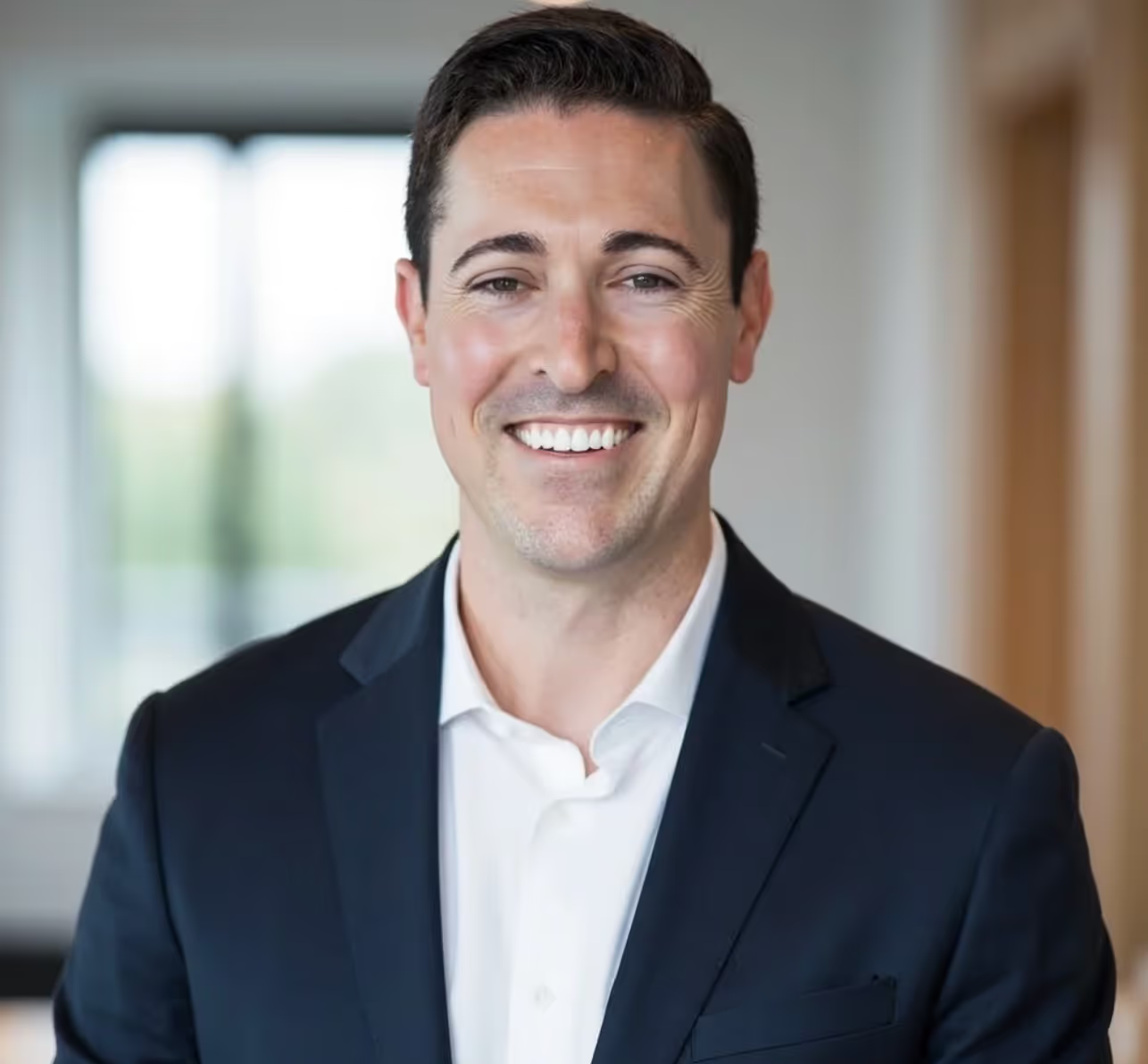
Grant Webster, CFP®, TPCP®
Founder, Wealth Advisor